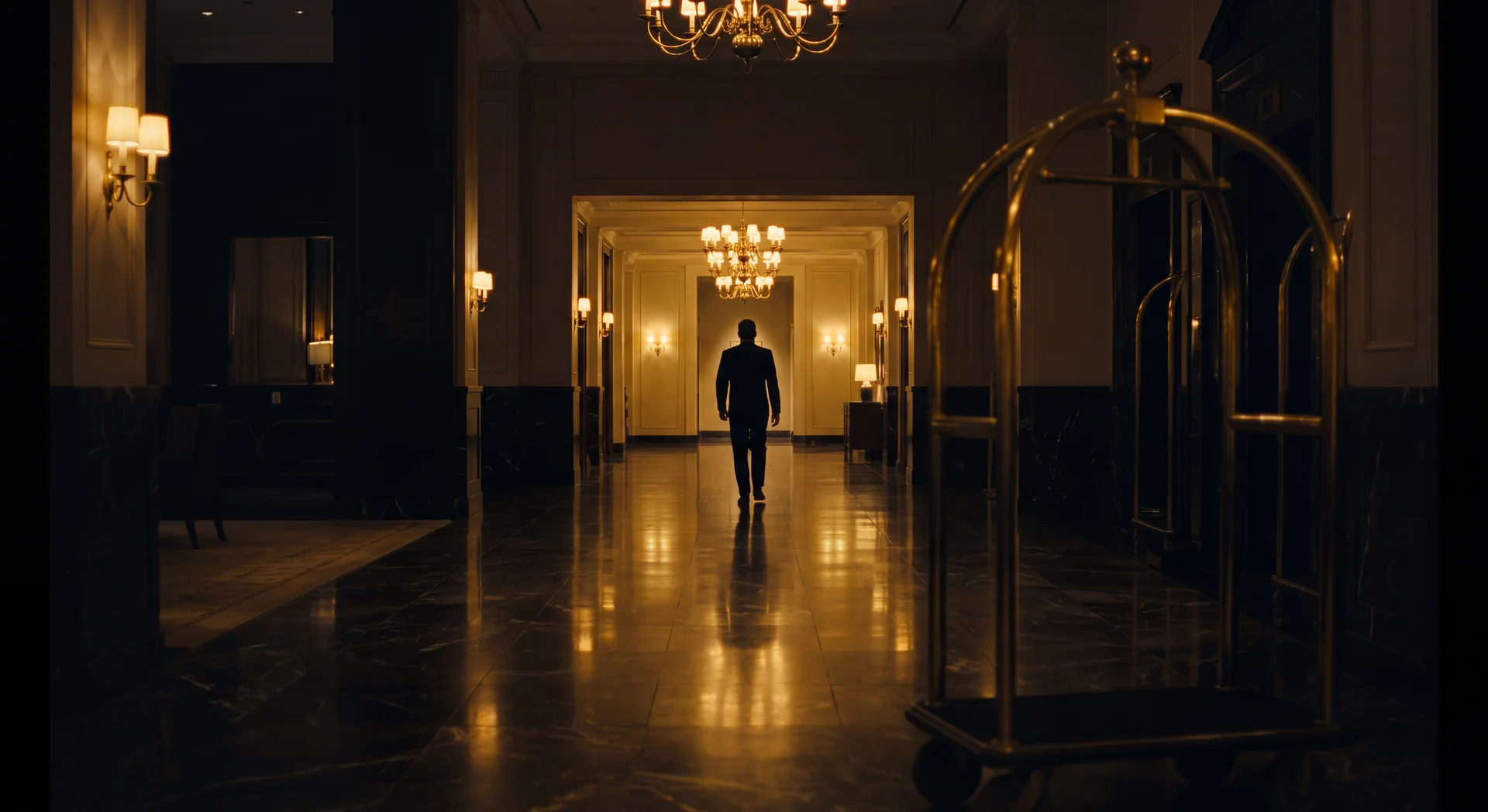
Marisol has worked the front desk at a 140-room independent hotel for six years. She speaks three languages. She has a degree in tourism administration. She remembers the names of guests’ dogs. She has, on more than one occasion, quietly fixed an issue with a honeymoon booking in a way that turned an angry couple into a five-star review.
Last Tuesday, between 7:00am and 3:00pm, she spent four hours and twenty minutes of her eight-hour shift answering three questions: what’s the wifi password, when does breakfast close, and is there a pool.
That is not the labor shortage. That is the cost of the labor shortage.
The real story is what we do with the Marisols we already have
The hospitality industry loves to talk about AI as a replacement narrative. The robot concierge. The unstaffed lobby. The self-check-in kiosk that “does the job of three.” Trade press loves this framing because it creates controversy. Vendors love this framing because it justifies a big-ticket sale. Operators, almost uniformly, hate it, because it is not what they want, it is not what their guests want, and it is not what the data supports.
The actual story is smaller, more important, and more humane:
- There are not enough front-desk agents to answer every call on the first ring.
- The front-desk agents we do have are spending more than half their shift on repetitive, low-value queries.
- Every minute they spend on those queries is a minute they are not spending on the work the guest actually wants from them, the fix, the recognition, the relationship.
AI’s job is not to replace Marisol. AI’s job is to give Marisol back her four hours and twenty minutes.
The numbers that frame the urgency
The labor shortage is not going away
The WTTC’s Future of the Travel & Tourism Workforce report (October 2025) projects hospitality at roughly 18% below required staffing by 2035, an 8.6 million worker gap in one sector, globally. The nearer-term picture is already live: AHLA’s January 2025 survey found 65% of U.S. hotels reporting staffing shortages, with front desk the second-most-shortage role.
Turnover compounds the shortage. BLS JOLTS data puts leisure and hospitality monthly separations near 5.8%, annualizing to roughly 70–75% turnover. The receptionist you hire today has a three-in-four chance of leaving before the year ends.
Labor is the single largest cost center, and it is still rising
The March 2026 BCG + NYU SPS “AI-First Hotels” report lays out the operator’s P&L reality with unusual precision:
Labor accounts for roughly 50% of gross operating margins, and labor costs rose 11.2% year-over-year.
BCG + NYU SPS, AI-First Hotels, March 2026
Half of GOP. Eleven percent annual increases. No labor-market relief in sight. This is not an environment where operators have the luxury of “adding headcount to solve the queue.”
AI’s job is to free the humans, not replace them
The BCG + NYU SPS analysis is explicit that the productive frontier for AI in hotels is not automation of the human role but augmentation of it, freeing staff from repetitive low-value work so they can focus on the high-touch, relationship-driving moments that actually produce guest satisfaction and repeat bookings.
McKinsey’s research quantifies the ceiling: approximately 40% of front-desk tasks are automatable with current-generation AI. Not 90%. Not “replace the receptionist.” Forty percent of the things Marisol does today could be handled by a system, and those are, almost without exception, exactly the four-hours-and-twenty-minutes kind of things.
EHL’s research frames it in plain language:
Multilingual chatbots are fielding inquiries, while automated check-ins and room assignments are freeing staff for high-touch service.
EHL Research, AI in Hospitality
And Deloitte, in its Future of Hospitality piece, lands on the clearest line in any consulting research on the topic: “handle the how so your people can focus on the why.”
The skills gap is the real story, and most operators are underinvesting in it
Buried in the BCG + NYU SPS report is one of the most strategically important numbers of the year:
Only 2.9% of travel and tourism full-time employees possess AI skills, compared to 21% in tech and media. AI-skilled hospitality roles are growing approximately 5% year-over-year.
BCG + NYU SPS, AI-First Hotels
The hospitality industry is not behind on AI technology. The tools work. The models are cheap. The integrations exist. The industry is behind on AI skills, on the workforce capability to absorb, deploy, and refine these systems in a way that actually reshapes operations.
That gap is both a risk and an opportunity. Operators who invest in upskilling their front-desk and reservations teams in the next 12 months will be running a materially different kind of business than operators who wait for the technology to “feel ready.” The technology is already ready. The workforce is catching up.
The FlowStay Operating Principle
Everything we build at FlowStay is governed by a single operating principle, which we are going to repeat in every piece of writing we publish:
Automate the repetitive. Elevate the human.
What this means, concretely:
Automate the repetitive
AI handles the four hours and twenty minutes of Marisol’s shift that are currently evaporating into wifi passwords, breakfast hours, and pool questions. It answers every call on the first ring, in the guest’s language, at any hour. It handles routine pre-arrival email. It pulls the returning guest’s profile before the second ring. It processes the three-line booking confirmation that takes the reservations coordinator fifteen clicks in the PMS.
Elevate the human
What is left for Marisol is the work she was actually hired to do. The honeymoon couple who just arrived exhausted. The guest whose flight was cancelled and who needs a room change. The complaint that requires judgment. The regular who remembers her name and expects her to remember his. The small, irreducible, high-touch moments that make a property feel like a place and not a product.
This is not a soft benefit. It is a measurable one. J.D. Power’s 2024 North America Third-Party Hotel Management Benchmark found staff service to be a top driver of overall guest satisfaction, with the highest scores flowing from properties where front desk agents had the time to be attentive, not from properties where they were fastest at answering repetitive questions.
Why this matters right now
Because the window is narrow.
The industry is entering a period, call it 2026 through 2028, in which three forces converge:
- AI capability is good enough to handle the 40% of front-desk work McKinsey identifies as automatable, at a cost that works for independent P&Ls.
- The labor shortage is structural, not cyclical. Marisol’s double-shifts are not going to end because the economy cools.
- Guest expectations are rising. The personalization gap, 74% of travelers want it, roughly 23% feel they get it, is widening every quarter.
Operators who deploy AI with the operating principle “automate the repetitive, elevate the human” in the next eighteen months will have the staff, the guest satisfaction, and the margin structure to compound through a difficult decade.
Operators who deploy AI with the operating principle “replace the receptionist” will discover, as too many already have, that removing the human does not remove the work, it just makes the work invisible until a guest standing in the lobby at 11pm does not know what to do, and books a Marriott on their phone.
What we’re building
FlowStay is an AI layer for independent hotels that is designed, end to end, to honor this operating principle. It answers every call with memory. It handles the inbound inquiries Marisol does not have time for. It pulls the returning guest’s full profile before she picks up the phone. It turns the website into a direct-booking channel that closes in real time. And it leaves Marisol with the four hours and twenty minutes she has been trying to reclaim for six years.
The tagline we have been testing on the back of our business cards:
Memory. Speed. More revenue per stay.
But the operating principle is underneath it, and it is the part we will not negotiate:
Automate the repetitive. Elevate the human.
That is the product. And, frankly, that is the thesis for why hospitality, of all industries, is the one where AI should most clearly be judged by what it frees humans to do, not by what it removes them from.
Marisol was hired for a reason. We think she should get to do it.