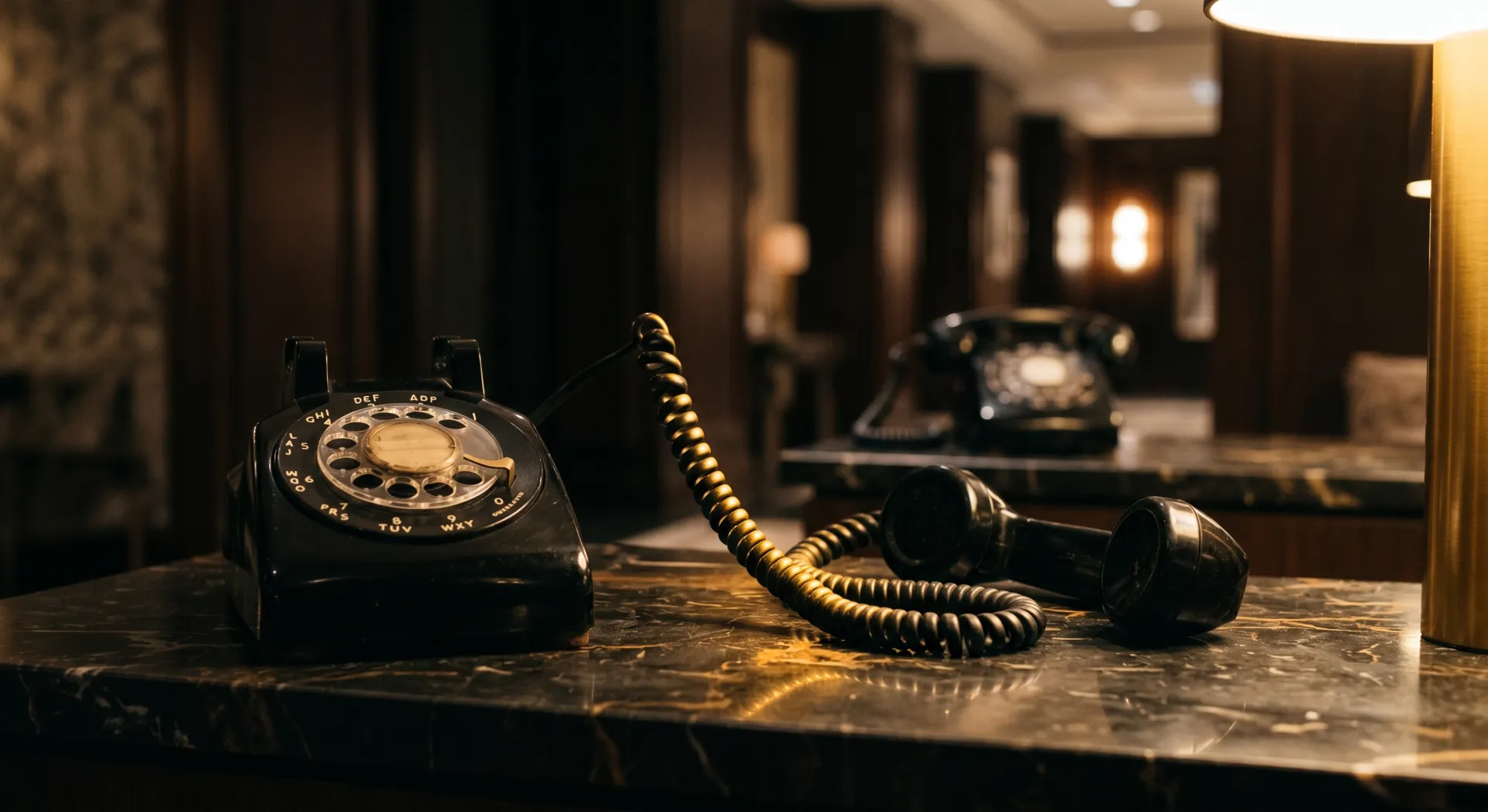
At 7:42pm on a Thursday a man named Alex calls a 120-room mountain lodge. He is deciding between two properties for a long weekend with his wife, and he has one specific question: does the lodge have a fire pit in the king suites, or is that only at the cabins. The website is vague. The Booking.com page does not mention it. He wants to hear a person confirm before he books.
The receptionist is with a walk-in. The phone rings four times, rolls to voicemail. Alex does not leave a message. He hangs up.
Here is what happens next. Most voice-AI vendors, and most hospitality operators, stop measuring at this point. The call is logged as “abandoned” or “missed.” It is counted, if at all, as a single negative outcome.
That is not one event. That is two.
Alex is now actively looking for the same information somewhere else. His next touch is not another call. It is a direct entry of the hotel’s name into a Booking.com search bar. He will book within the next 17 minutes, at 7:59pm, at an OTA commission rate north of 18%. The second event, the booking that did happen, just got attributed to a channel the hotel pays for. The first event, the unanswered call, is the cause. The industry has been writing off the first event for a decade, because it does not get booked. It is the second event, the resolution, that reveals the full economics of the miss.
This is the callback economy. Every abandoned call is not one lost interaction. It is the kickoff of a 5-to-30-minute window during which the guest is going to close the booking somewhere, and the hotel’s only remaining lever is how fast it can get a callback into that window.
Speed-to-lead is the cleanest lever in the enterprise playbook, and the cheapest in hospitality
The canonical speed-to-lead study is the MIT / Kellogg / InsideSales Lead Response Management Study, led by James Oldroyd, based on three years of data, 15,000+ leads, and 100,000+ call attempts across B2B sales environments. The headline finding, which has been reprinted across enterprise sales literature for 15 years:
Contacting a web lead within 5 minutes vs. 30 minutes makes the lead 21 times more likely to qualify. The odds of actually reaching the lead at all drop 100-fold at 30 minutes.
Oldroyd et al., Lead Response Management Study, MIT / Kellogg
Harvard Business Review’s 2011 follow-on audit of 2,241 US firms, The Short Life of Online Sales Leads, confirmed and sharpened the number:
Firms that responded within 1 hour were 7 times more likely to qualify a lead than those at 2 hours, and 60 times more likely than those waiting 24+ hours. 78% of online sales go to the first company to respond. The average industry response time in our audit was 42 hours.
Oldroyd, McElheran, Elkington, HBR
Sit with the 78% number. It says the entire competitive game in online lead conversion is not price, not product, not positioning, it is which company calls back first. In B2B sales, where every industry has spent a decade on lead automation, this has been internalized. In hospitality, where the direct channel is a much higher-margin product, it has not.
What hospitality actually loses to speed
The primary-source hospitality numbers make the stakes concrete.
Revinate’s 2024 Hospitality Benchmark Report, based on 4.3 million analyzed calls, finds:
Inbound voice converts at approximately 50%. Outbound calls to prior guests generate $1,748 incremental revenue per room per year for North American hoteliers.
Revinate, 2024 Hospitality Benchmark Report
A 50% inbound conversion rate is an order of magnitude higher than any other direct channel at an independent hotel. The phone is still, as we wrote in a March post, the highest-intent funnel most properties own.
Travel Outlook’s published operator benchmarks give the parallel number for the miss side:
30–40% of hotel calls go unanswered during peak periods. Agent-handled abandonment runs under 5%. 65–70% of qualified reservations calls convert to a booking when reached by an agent.
And Invoca’s 2025 Call Conversion Benchmarks, based on 60 million+ phone calls across 9 industries, gives the cross-industry baseline for the underlying problem:
39% of callers to businesses never reach a human. Of the 35% of calls that are leads when answered by a person, 37% convert on the call.
Invoca, 2025 Call Conversion Industry Benchmarks
The composite: a hotel call has a 50% baseline conversion. At least a third of callers are routed to voicemail or a hold long enough to trigger abandonment. The abandonment is, in most cases, not the end of the guest’s booking intent; it is the handoff of that intent to whichever OTA catches them next.
The cost of the miss, per call, in a real P&L
Alex’s Thursday-night call has a specific dollar value. We can compute it.
Per Kalibri Labs’ Book Direct Campaigns 2.0, the per-occupied-room acquisition cost at a typical full-service property:
Property direct: $2.61. Brand.com: $9.21. OTA: $22.43.
Kalibri Labs, Book Direct Campaigns 2.0
A direct phone booking costs $2.61 to acquire. The same guest, who abandons the call and reverts to the OTA, costs the property $22.43 for the exact same room on the exact same night. That is a $19.82 per-room swing in acquisition cost.
SiteMinder’s 2024 Hotel Booking Trends, based on 125 million reservations across 44,500 hotels:
Direct bookings average $519 per booking vs. $320 on OTAs, a 62% revenue-per-booking premium on direct.
SiteMinder, Hotel Booking Trends 2025
So Alex’s unanswered call, if he abandons to an OTA and books a 3-night stay, costs the property approximately:
- $19.82 × 3 nights = $59.46 in incremental acquisition cost
- ($519 − $320) = $199 in revenue-per-booking premium (because OTA bookings are, on average, lower-value)
- Plus the commission itself:
18% × ($320 × 3) = **$173 paid to the OTA**
Total economic delta per abandoned call that resolves to an OTA booking: roughly $430. That is the value, per miss, of a receptionist who picked up on the third ring instead of the fifth.
At 30 inbound calls a day, a 30% abandonment rate, and a conservative assumption that half of abandoned callers resolve to an OTA booking of the same property: 30 × 0.30 × 0.5 × $430 × 365 = ~$707,000 per year in OTA-leakage cost at a single 100-room independent. That is the shape of the callback economy.
Why hospitality has not solved this yet
The enterprise speed-to-lead problem has been a solved problem, in software terms, for a decade. B2B sales stacks have callback automation, round-robin routing, dialer integration, and SLA alerting. The tools exist.
The reasons they have not arrived at independent hospitality are specific and fixable:
- Labor shortage. AHLA’s January 2025 survey puts 65% of US hotels at staffing shortages. You cannot implement an SLA of “call back within 5 minutes” if there is nobody at the desk to make the call.
- No identity on the missed call. The caller ID gives a number. The PMS does not know the number. The receptionist, if she calls back, is calling a stranger.
- Channel fragmentation. The inbound phone system, the PMS, the booking engine, and the CRM are four different surfaces. A callback requires knowing who called, what they asked, and whether they have already booked elsewhere. Without a unified layer, the callback is blind.
- Hour-of-day mismatch. Alex called at 7:42pm. The reservations manager works 9-to-5. Even if the miss is detected, the callback does not happen in the 5-to-30-minute speed-to-lead window; it happens the next morning, by which time the guest has booked.
Every one of those four is a memory and orchestration problem. Every one of them is now addressable with the current generation of voice AI plus an identity substrate.
What the callback economy product has to do
A real callback product for hospitality, one that can actually collect the $700K-per-property annual opportunity, has to close the loop on five things:
- Detect the miss in real time. Not batched nightly in a call report. The system has to know the receptionist did not pick up, and the guest did not leave a message, within seconds of the hangup.
- Resolve identity where possible. The caller ID is a hook. Cross-reference against the PMS profiles, the booking-engine session logs, the prior-stay phone numbers, the OTA folio phone numbers. The caller is usually already known to the property, just not to the inbound queue.
- Classify intent from context. Time of day, recent booking-engine activity on the property’s site, whether the caller has an open reservation, whether they are a returning guest. Alex at 7:42pm with an active booking-engine session and no open reservation is a different callback target than a checkout-call at 11am.
- Call back within the 5-minute window. Not the next business day. Five minutes. Per the MIT/Kellogg primary-source data, this is a 21× qualification multiplier. The callback has to be automated, not scheduled.
- Pick up the thread where it dropped. “Hi Alex, we missed you a few minutes ago when you called about the mountain lodge. I can answer your fire pit question right now, it’s a gas pit in the king suite balcony, and if you’d like I can hold a king suite for Friday through Sunday at $389 a night with a direct-booking rate confirmation.” The callback is only useful if it can close the conversation the guest wanted to have the first time.
Every one of those five is, structurally, a job for a voice AI sitting on top of a guest-memory layer. A human SDR, at the economics of an independent hotel, cannot do it. A voice-AI stack with identity, context, and outbound calling capability can.
This is what FlowStay’s callback architecture does, and it is the operational counterpart to the Automate the Repetitive, Elevate the Human principle: the receptionist at the desk continues to handle the nuanced walk-in in front of her, and the voice agent closes the loop on the ring she did not catch at 7:42pm.
The callback is also a cross-session memory problem
The other thing the callback product has to get right, which most speed-to-lead products in enterprise sales do not, is memory continuity.
Alex’s call is, often, not his first touch. He likely visited the hotel’s website earlier that day. Maybe he abandoned a booking in the engine. Maybe he had an email exchange two weeks ago about a corporate rate. Each touch is a signal. In the vast majority of hospitality stacks, each touch lives in a different system, with no resolution between them. The website session is a cookie. The phone call is a caller-ID. The email is a thread. The booking engine is a session_id.
A callback that opens with “Hi Alex, I saw you were looking at our mountain lodge earlier this evening and tried to call; I can confirm the king suite has a fire pit on the balcony and hold you one for Friday” is an order of magnitude more effective than a callback that opens with “Hi, this is the mountain lodge returning your call, how can I help you.” The difference is the memory layer.
This is precisely the structural argument we made in Your Returning Guest Has 2.3 Profiles in Your PMS and Unreasonable Hospitality Was Always a Memory Problem. The callback is the place where the memory layer proves its return on investment, because the callback is where the speed-to-lead multiplier compounds with the identity multiplier.
The math, composed
Put the pieces together. A 100-room independent at 75% occupancy runs roughly 30 inbound calls per day. At a 30% abandonment rate, the property has 9 missed calls per day. At a 50% callback-to-booking conversion rate (significantly better than the 10% typical of cold SDR callbacks, because these are in-funnel guests with documented intent), and an average direct booking value of $519 per SiteMinder:
- 9 missed calls × 0.50 conversion × $519 × 365 days = ~$852,000 annualized recoverable direct revenue
Net of the $22.43 OTA acquisition cost on the calls that would have defaulted to OTA booking otherwise, the actual profit impact is closer to the $700K figure in the earlier calculation. Still real money. At a 100-room independent, that figure is meaningfully larger than the labor cost of the entire front-desk function.
And here is the part that should make every independent operator pause: the infrastructure to collect it, identity resolution, real-time miss detection, voice-AI callback within five minutes, context-aware conversation, is now buildable at a price point that is a small fraction of the $700K opportunity.
The two-event frame
Every abandoned call is two events. The miss, and the resolution. The industry has been measuring the first one for a decade. The revenue is in the second one.
The product that wins the callback economy is the product that collapses the gap between the two, from “next business day” to “five minutes,” and closes the conversation the guest tried to have the first time.
Alex called at 7:42. At 7:47, one of two things happens. Either the mountain lodge calls him back, answers the fire pit question, and books him direct at $389. Or the lodge never calls, and Booking.com closes the same stay at 7:59, at a $430 all-in cost to the property.
Five minutes. Twelve minutes. $430.
That is the scoreboard. It has been the scoreboard for a decade. The industry has just been playing with the wrong clock.