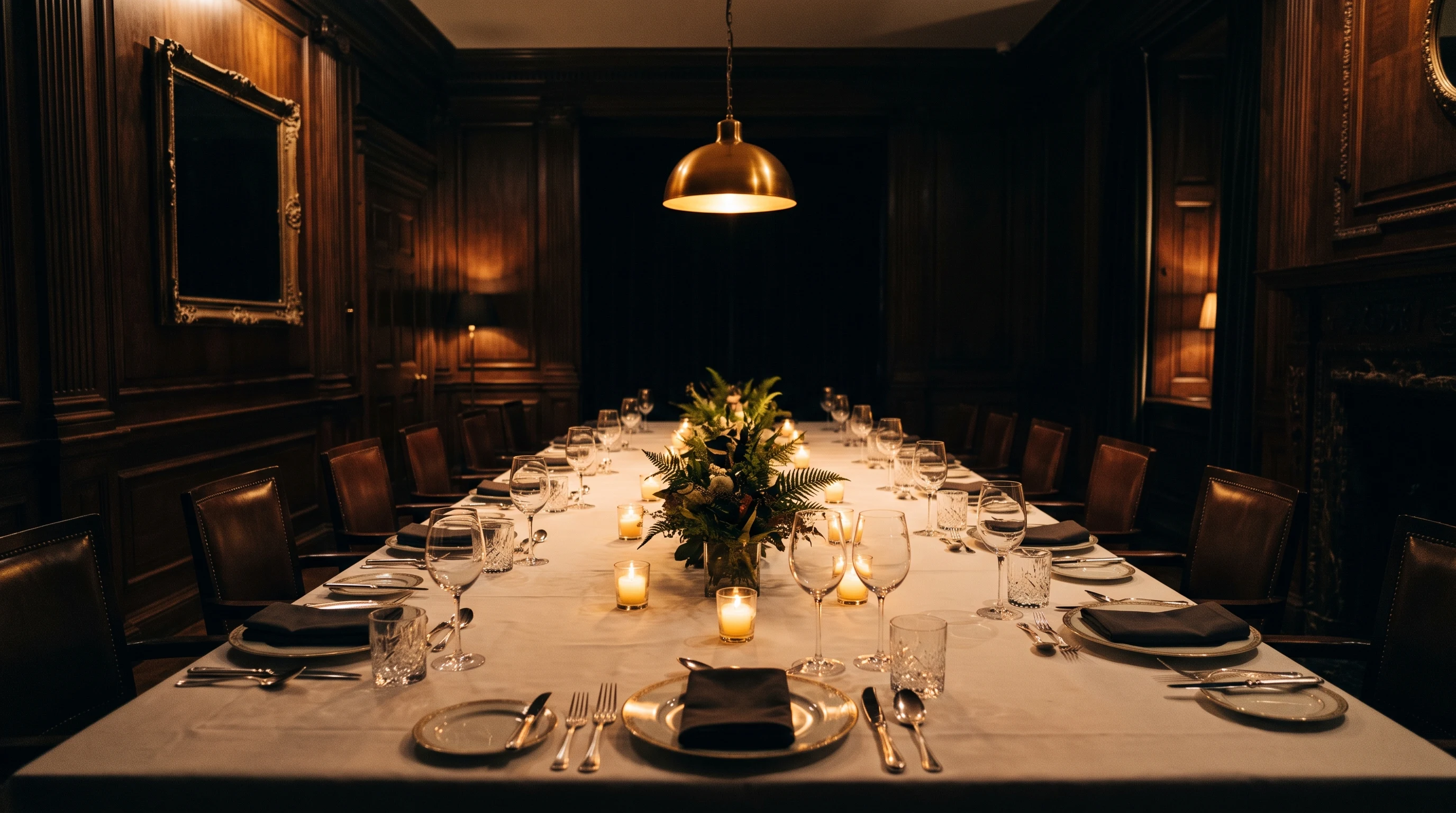
At 9:14 on a Thursday night, a woman sits at her kitchen island with a laptop and a half glass of wine, booking her mother’s seventieth birthday dinner. She has already picked the restaurant. It is a coastal independent she ate at once, in June, and has not stopped describing since. She wants the private room with the long table and the window over the water. Fourteen people. A Saturday in October. She has already decided to spend real money.
She opens the reservations page. She picks the date. She opens the party size dropdown.
It stops at eight.
Underneath it, in small gray type: for parties of nine or more, please email us.
So she emails. 9:19 p.m., Thursday. The message lands in a shared inbox that nobody will open before Monday, if anybody opens it at all. By Sunday afternoon she has booked somewhere else, or she has booked nowhere and moved the party to her sister’s house, which happens more often than the industry wants to believe.
Call it the party-size cliff: the point on your booking form where the guest with the largest check in the building stops being a customer and becomes an email address.
Here is the uncomfortable part, and the reason this is worth a long read instead of a snarky post. The cap is not a bug. Nobody forgot to raise the limit. Somebody chose that number, on purpose, for a good reason.
The cap is not a mistake. It is a rational revenue decision.
Start by conceding the operator’s case, because the peer-reviewed evidence is on the operator’s side.
Gary M. Thompson of the Cornell School of Hotel Administration studied exactly this question, which parties a restaurant should serve and which it should turn away. His finding is blunt:
Compared to smaller parties, larger parties typically take longer to dine and spend less per person.
Gary M. Thompson, Cherry-Picking Customers by Party Size in Restaurants, Cornell School of Hotel Administration
And the operational conclusion that follows from it: large parties, he writes, “are the logical candidates for not being served.”
That finding demolishes the easy version of this argument. The easy version says big tables are big money and your form is leaving it on the floor. That is not what the research says. An uncontracted twelve-top is genuinely a worse use of your dining room than two sixes. It occupies more square footage for longer. It orders more cautiously per head, because somebody at that table is quietly worried about how the check gets split. It concentrates risk: one organizer, one phone number, and a no-show that removes fourteen covers from a Saturday in a single text message.
The floor manager who set that dropdown to eight is not lazy. She is doing revenue management with the only lever her booking form gave her.
But look closely at what the lever is actually for. She is not trying to refuse the party. She is trying to refuse the party on those terms. What she wants is the same fourteen people arriving under a different agreement: a prix fixe at a set price per cover, a beverage package, a minimum, a deposit that makes the date real.
That agreement is a well-worn instrument in hospitality. On the hotel side of the house it is written down and enforceable, and you can read the language in executed contracts. Standard food and beverage minimum clauses commit a group to a floor, in one Hyatt agreement “a minimum of $50,000.00 in banquet food and beverage revenue (excluding tax and service charge),” with liquidated damages owed if the group spends under it. The contract does not make the guests hungrier. It makes the revenue certain, and certainty is the entire product a private room sells.
So the cap has a job, and the job is conversion. Convert a liability into a contract. It is the correct instinct, implemented with the wrong tool, because the tool has exactly one setting: stop. Whether the conversion ever happens depends entirely on what sits at the bottom of the cliff, and on whether anyone is standing there.
The cliff is a configuration field with a default value of eight.
This is not folklore. It is a setting, shipped by the major booking platforms, documented in their own help centers.
Shift4’s reservation setup wizard walks the operator through it in plain language. “To properly accommodate larger parties,” the documentation reads, “you may prefer that they contact your restaurant directly rather than book online.” Then the instruction: “Set the largest party size eligible for online reservations.” And the consequence, stated without euphemism: “Parties larger than this number will not be able to complete an online reservation.”
That is the cliff, described by the people who built it, and their reasoning is sound. Large parties should be handled by a person.
The default matters more than the setting, because most operators never touch it. ResDiary is explicit: “When a diary is built the online maximum party is automatically set to 8 covers.” Eight, out of the box, on day one, before anyone has thought about it. Every restaurant that never opened that screen is running a policy it did not write.
The cliff is also baked below the interface, into the protocol layer that connects restaurants to search. Google’s Actions Center specification for reservations includes a field for above-maximum parties, and the standard behavior it defines is a redirect to a telephone number: “For parties larger than max_party_size, please call the restaurant.” The largest discovery surface in the world knows about your big-party guest and hands her a phone number.
Here is the twist that makes the whole thing sting. The table is usually available. It is simply hidden from the web. Yelp described the gap precisely when it opened up its Guest Manager inventory in July 2026: restaurants can now expose “their full table inventory to Yelp Host, including in-house-only slots,” and set a separate, higher party size limit for phone bookings, because “when a guest calls for a larger party or a time that isn’t showing online, Host can find it and book it.”
There are two inventories. The one the internet can see, and the real one. The big party is routed to the real one through a human bottleneck.
And this is not a restaurant quirk. Hotels run the identical cliff, at almost exactly the number in this post’s title. IHG’s own guidance: “You can reserve up to nine rooms online, of the same type and rate from any device.” Need ten? “To book a meeting, event or block of 10 or more rooms, contact the IHG Group Center or use IHG’s online group booking and RFP submission site.” Nine rooms is a transaction. Ten rooms is a form, a queue, and a wait.
Across the industry the same architecture repeats: self-service below the line, humans above it, and the biggest booking on the property is the one that has to wait for a human who is, at that moment, running a Saturday service.
Seventeen hours to book one dinner, and 42% give up.
Until recently, the size of the cliff was a hunch. Then the largest reservation platform in the country measured it, and published the number, and set its own threshold at ten.
In September 2025, OpenTable released research conducted by WALR, surveying 1,524 US respondents who had dined with a group of ten or more in the previous five years, with fieldwork run August 5 to 13, 2025. It is vendor-published research, commissioned alongside a product launch, and it should be read with that in mind. The findings are still the clearest picture the industry has:
It takes an average of 17 hours to find and book the right venue for private and group dining, and nearly half (42%) of respondents said they’ve abandoned booking altogether due to the hassle.
OpenTable Launches All-in-One Marketplace for Private and Group Dining, September 2025
Seventeen hours. Not seventeen minutes of form-filling. Seventeen hours of a person’s life spent emailing venues, waiting, comparing PDFs, chasing, and re-explaining the same date and headcount to the fifth restaurant in a row. That is the shape of the search when there is nobody standing at the bottom of the cliff.
And 42% quit. Not “chose a competitor.” Quit. The dinner did not happen anywhere.
Now put the third finding next to Cornell’s, because together they resolve the whole argument. In the same survey, 66% of respondents said they are willing to spend more per person for a private or group dining venue than they would a la carte, and 72% said they would rather host a group dinner at a restaurant than at home.
Both things are true. Thompson is right that the uncontracted large party spends less per head and stays longer. These respondents are right that they will pay a premium for a proper private booking. The gap between those two sentences is not a contradiction. It is a contract. The premium does not live in the guest’s appetite, it lives in the agreement: the per-cover prix fixe, the beverage package, the minimum, the deposit that makes October real in August.
Which means the operator’s instinct was correct twice over. Cap the uncontracted party. Sell the contracted one. The only broken piece is the machinery that is supposed to carry a guest from the first state to the second.
The bottom of the cliff is an inbox, and the inbox is where the contract dies.
So what is that machinery, at most properties, on a Thursday night?
An email address.
Cross-industry benchmarking on that channel is not encouraging. SuperOffice’s Customer Service Benchmark, vendor-published research in which one email template with two simple questions was sent to 1,000 companies, found that 62% of companies do not respond to customer service emails at all. Among those that did, the average response time was 12 hours and 10 minutes. And 90% never acknowledged that the email had arrived.
That study is cross-industry, not hospitality-specific, and it measures a support inquiry rather than a group dining lead. Take it as a directional read on what a shared inbox does in the wild, not as a measurement of your restaurant. But every operator reading this already knows which of those three numbers is the painful one. Not the 62%. The 90%. For at least twelve hours, our birthday organizer has no idea whether her message reached a human, a spam filter, or an address that stopped being monitored when the events coordinator left in March.
She does the only rational thing. She emails three more restaurants. That is how seventeen hours happen.
And it is why the response clock decides the outcome. Harvard Business Review’s audit of online lead response, conducted by James Oldroyd, Kristina McElheran and David Elkington across 2,241 US companies, remains the cleanest study of what waiting costs. The average response time, among firms that answered within thirty days, was 42 hours, and 23% never responded at all. The consequences of the delay were severe: firms that made contact within an hour were nearly seven times as likely to qualify the lead as those that waited just one hour longer, and more than sixty times as likely as companies that waited twenty-four hours or more.
That research is from 2011, and it studied B2B web leads, not birthday dinners. The mechanism it describes has aged well, because the mechanism is not about industry. It is about a person who is actively shopping, in a session, with tabs open, and who will make her decision inside that session or hand it to whoever answers first. A group dining inquiry is a lead with a date attached and four competitors already in the browser.
The property that answers at 9:20 p.m. is not slightly ahead of the property that answers Monday at 11. It is in a different competition.
The cap should open into a conversation that builds the contract on her screen.
The fix is not “raise the limit to twenty.” Raising the limit takes the one revenue-management lever the operator has and throws it away, and Thompson’s research says that lever is protecting something real.
The fix is to change what happens at the bottom of the cliff. Keep the cap. Replace the email address with a conversation that builds the contract right there, while she is still on the page, still holding the glass of wine, still emotionally committed to the room with the window over the water.
Not an email form that promises a callback. Not a chatbot that collects her details and promises the same callback in a friendlier font. A conversation, on the phone or on the site, that does the three things a good events coordinator does, and does them at 9:19 on a Thursday.
It asks the qualifying questions in the first minute. Date, headcount, and the number that actually governs the booking: what she is hoping to spend per person. Every experienced coordinator asks that question early. Almost no web form ever does.
It shows her the room. This is the part that has no equivalent in a phone tree or an inbox. As the agent talks, Flowvue renders the experience on her screen, on cue: the private room, the long table, the window over the water in evening light. She is not reading a capacity chart. She is looking at her mother’s birthday.
Then it builds the contract in front of her. The prix fixe options appear, priced per cover. She picks one. The running total assembles on screen against the ceiling she named a minute earlier. She adds the wine pairing and watches the total move past her number, and she is the one who says “let’s do the second tier instead,” before anybody has to have an awkward conversation about budget. When the shape is right, the deposit is taken in the call, PCI-compliant, by voice or keypad, on the terms the property set.
Deposit only after yes. The order matters, and most systems get it backwards by asking for commitment before the guest can see what she is committing to.
Talk, show, and remember. The last verb is the one that compounds. Next August, when she calls about the seventy-first, the agent already knows the room she loves, the shellfish allergy at seat four, and what she spent last time. Remembered guests spend more, and a group organizer who has been remembered does not shop the other four restaurants at all.
None of this removes the operator’s control. The cap stays at eight, or ten, or twelve, wherever the floor manager wants it. Availability rules stay. Minimums stay. Blackout dates stay. What changes is that the cliff stops being a dead end and becomes a doorway with somebody standing in it.
Now put it on the P&L, with round hypothetical numbers, invented for illustration and not drawn from anyone’s books. Take a 140-room independent with a 16-seat private room. Suppose catching the after-hours inquiries adds two contracted parties a month, twelve covers each, at a $200 per-cover prix fixe. That is $2,400 a party, $4,800 a month, roughly $58,000 a year, before wine, before the incremental rooms those out-of-town guests book upstairs. The room already exists. It is already built, already on the floor plan, already staffed on Saturdays. The only thing that was missing was somebody to answer at 9:19 on a Thursday and turn a headcount into an agreement.
There is a restaurant in New York whose reservations page, as of August 2026, says the quiet part out loud: “For all party sizes of 7 or less, kindly make the reservations over Resy,” and “if you would like to book a large party, please send an email to info@.” The cliff is at seven. Seven. And what is waiting at the bottom of it is an inbox.
That is not a criticism of one restaurant. It is the industry standard, printed plainly, on page after page like it. The highest-value booking on the property, the one with fourteen covers and a contract and a wine list attached, is routed to the slowest channel the business operates.
Your form stops at ten. Your best table starts at twelve. The distance between those two numbers is not a design flaw. It is a contract that never got written, because nobody was there to write it.
FlowStay is taking on pilot properties now: a 30-day pilot at no cost, live in 24 hours on supported systems, no IT lift. Bring us the inquiry nobody gets to until Monday. Write to eric@flowstay.ai.
And on a Saturday in October, at the hour she asked about, fourteen people find their names at one long table in front of the window over the water. Her mother sits at the head of it, facing the view, seventy years old that week, telling a story from 1978 with both hands. The courses her daughter chose in August arrive without anyone ordering. Nobody splits a check. Nobody looks at a phone. The October light comes off the water and moves slowly down the table, and the dinner that nearly happened at her sister’s house is happening here instead, in the room she wanted, at the table she saw.